
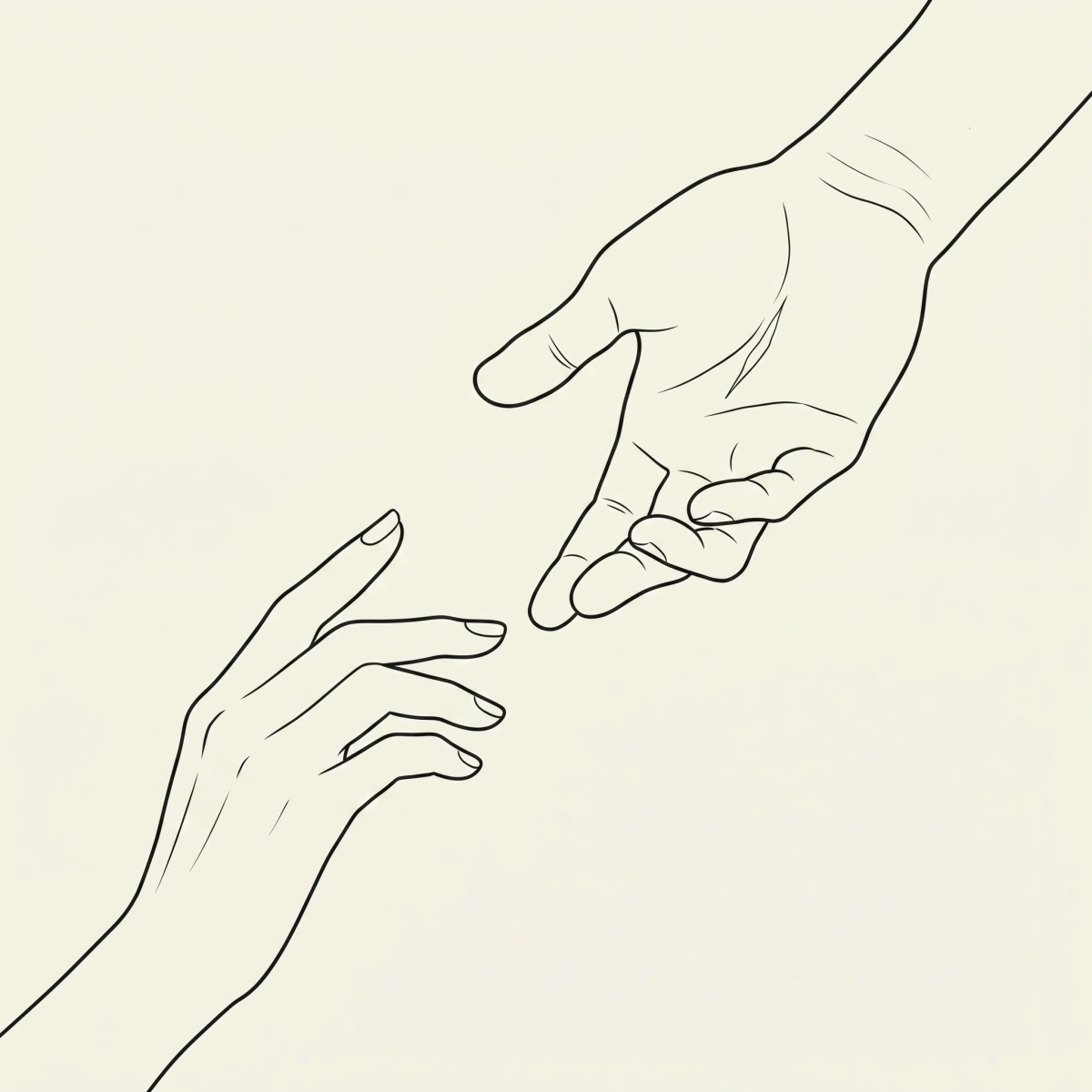
My Lord and my God
Following the crucifixion of Jesus, the disciples had locked themselves away, terrified that the religious leaders who executed Him would come for them next. When Jesus miraculously appeared to the group in that locked room, Thomas was absent. Upon hearing the others’ joyful claims that their Saviour was alive, Thomas remained stubbornly sceptical, making his conditions for belief very clear:
“Unless I see the nail marks in his hands and put my finger where the nails were, and put my hand into his side, I will not believe” (John 20:25, NIV)
A week later, Jesus suddenly stood among them again. He did not argue with Thomas or harshly rebuke him. He simply offered the exact physical proof Thomas had demanded, saying,
“Put your finger here; see my hands. Reach out your hand and put it into my side. Stop doubting and believe” (John 20:27, NIV)
Faced with the scarred hands of Jesus, Thomas immediately responded with one of the most profound declarations in the entire Bible:
Thomas said to him,
“My Lord and my God!” (John 20:28, NIV)
To fully grasp the massive weight of those two specific titles – Lord and God – we have to pause this moment and rewind all the way back to the very first breath of the Scripture.
In the beginning, we are introduced to a God of breathtaking power and infinite distance.
“In the beginning God created the heavens and the earth” (Genesis 1:1, NIV).
The Hebrew word used here is Elohim. This is the sovereign Architect who exists completely outside of time, speaking galaxies into existence from nothing. He is majestic, all-powerful, and utterly transcendent.
But just one chapter later, the story shifts in a profoundly beautiful way. As the narrative zooms in on the creation of humanity, a new name is revealed: Jehovah (translated as “the Lord”).
“This is the account of the heavens and the earth when they were created, when the Lord God made the earth and the heavens” (Genesis 2:4, NIV).
This is the moment the all-powerful Creator gets His hands into the dirt. Elohim creates the cosmos by speaking; Jehovah creates mankind by touching, carefully molding the dust and breathing His own life into our lungs.
This was the beginning of a beautiful, asymmetrical mystery – the infinite Potter stooping down to intimately bind Himself to the finite clay. He is a loving God who deeply desires fellowship with the ones He made. We see this tender closeness in Eden, where the Creator of the universe simply wanted to be near us:
“Then the man and his wife heard the sound of the Lord God as he was walking in the garden in the cool of the day” (Genesis 3:8, NIV).
But that perfect closeness was shattered by human recklessness. We chose rebellion over relationship. The entry of sin tore a devastating chasm between a completely holy God and a broken humanity. Instead of walking with the Lord, man hid in the bushes in fear and shame.
Yet, God refused to let our story end in ruin. When humanity deserved nothing but distance, the Lord reached across the divide. We see this relentless grace when He reaches out to a dark world through Noah, promising,
“But I will establish my covenant with you” (Genesis 6:18, NIV)
God was proving that He would not abandon the clay.
To permanently bridge the chasm our sin created, God set a master rescue plan in motion. He didn’t just shout a promise from heaven; He etched it into human history through a specific, perfectly imperfect bloodline. He chose Shem’s descendant, Abraham, and passed the promise down generation by generation: to Isaac, to Jacob, through the messy and broken tribe of Judah, down to the royal line of David, ultimately culminating in the birth of Jesus.
On the cross, that centuries-long pursuit reached its climax. The Creator didn’t just demand a sacrifice to fix our recklessness; He stepped into the mess of our world and took the blow Himself. By His blood, sin was completely defeated. The ultimate covenant was kept, and the chasm was permanently closed.
Now, carry all of that history back into the upper room.
As Thomas looks at the scarred hands of Jesus, he doesn’t just realize his friend is alive. The entire weight of biblical history crashes over him. He sees the physical proof that the infinite Creator stepped into the mess to bleed for His creation. By calling Jesus “My God” (Elohim), Thomas recognizes the sovereign, uncreated Architect of Genesis 1, the One who holds the infinite power of the cosmos.
And by calling Him “My Lord” (Jehovah), Thomas recognizes the intimate, covenant-keeping God of Genesis 2 – the One who walked in the garden, who pursued a broken humanity, who traced a promise through the bloodline of Judah, and who ultimately allowed Himself to be broken on a cross to keep His word.
The scars were the undeniable proof that Elohim and Jehovah are the exact same person. God didn’t just love us from a distance; He came near.
But Jesus’s final response to this breathtaking confession isn’t just for Thomas. It is a loving, gentle promise reaching across thousands of years, spoken directly to every skeptic, doubter, and broken person who would ever read this story:
Then Jesus told him,
“Because you have seen me, you have believed; blessed are those who have not seen and yet have believed” (John 20:29, NIV).