
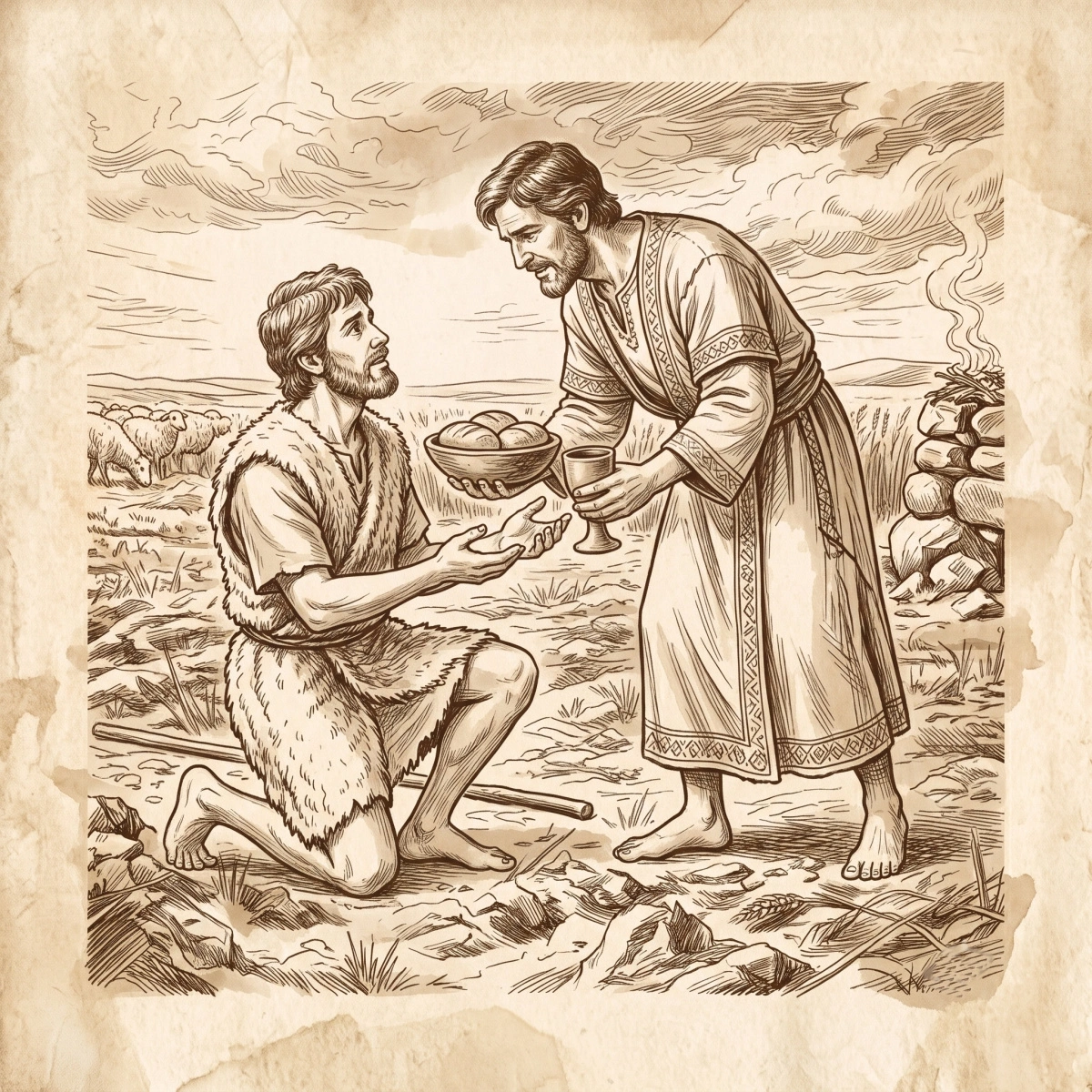
The Royal Encounter
The book of Genesis is filled with monumental figures, but few are as fascinating or as sudden as the man who steps onto the page in chapter 14. Abram has just returned from a gruelling military rescue mission. The dust is settling, the adrenaline is fading, and out of nowhere, a mysterious figure approaches him in the valley of Shaveh.
His name is Melchizedek, and his brief interaction with Abram establishes profound theological precedents that echo all the way into the New Testament.
1. A Righteous King in an Unlikely Place
The ancient Near East during the time of Abram was largely a landscape of idolatry, polytheism, and moral decay. Yet, right in the middle of this spiritual darkness, we find Melchizedek. He is the King of Salem (an early name for Jerusalem) and a “priest of God Most High.”
It is a powerful reminder that God is never without a witness. Even before the nation of Israel existed, and before the Mosaic covenant was established, God had a righteous king operating in the most unlikely of places, faithfully maintaining the worship of the true Creator.
2. A King of Peace with Hands Untainted by Blood
The name “Salem” translates to “peace.” Melchizedek stood in stark, beautiful contrast to the surrounding rulers. While the other kings of the region – like Bera, the king of Sodom – were ambitious warlords steeped in conflict, conquest, and violence, Melchizedek ruled a city of peace.
When Abram returned from the slaughter of the kings, his own hands were stained with the harsh realities of war. Yet, he was met by a king whose hands were completely untainted by blood. Melchizedek did not ride out to meet Abram carrying a sword to claim the spoils; he came carrying bread and wine to offer restoration.
3. Recognizing El Elyon
When Melchizedek greets Abram, he does not invoke the local Canaanite deities. Instead, Genesis 14:19 (NIV) records his blessing: “Blessed be Abram by God Most High, Creator of heaven and earth.”
The Hebrew term he uses is El Elyon. When Abram hears this title, a profound moment of recognition occurs. Abram realizes immediately that this foreign king is calling upon the exact same God that he himself serves. Despite having no shared ancestry and no prior introduction, their shared faith in the one true Creator instantly unites them.
4. The King, The Priest, and The Eternal Order
This meeting in the valley is a convergence of the most important biblical offices. Melchizedek stands uniquely as both a King and a High Priest. In the ancient world – and later in Israelite law – these roles were strictly separated. In the nation of Israel, you could not be both a king and a priest. The Law of Moses locked the priesthood to the tribe of Levi, while the royal dynasty was later established through the tribe of Judah, keeping the two offices strictly separated.
It would be a theological injustice to look at Melchizedek and not see the vivid, prophetic picture of Jesus Christ. Because Melchizedek held both offices, he became the blueprint for the Messiah. Centuries later, King David in Psalm 110:4 (NIV) prophesied about the coming Christ: “The Lord has sworn and will not change his mind: ‘You are a priest forever, in the order of Melchizedek.'”
The New Testament book of Hebrews dedicates chapters to this exact point: Jesus did not inherit His priesthood through the temporary, law-bound line of Aaron. He inherited it through the eternal, royal order of Melchizedek. Jesus is our ultimate King of Righteousness and King of Peace who also serves as our High Priest.
5. The Duty of a Priest: Bread, Wine, and Perspective
Genesis 14:18 (NIV) tells us, “Then Melchizedek king of Salem brought out bread and wine.”
Before Melchizedek preaches, he provides. He recognizes a profound human truth: a physically weak, exhausted man who has just returned from war does not primarily need a theological lecture or a gospel presentation; he needs food. Melchizedek performs his priestly duty by ministering to Abram’s immediate, physical needs first, restoring his strength.
Only after nourishing him does Melchizedek offer the spiritual perspective Abram needs. He says in Genesis 14:20 (NIV), “And praise be to God Most High, who delivered your enemies into your hand.” It would have been easy for Abram to become prideful after a massive military victory. Melchizedek steps in as the priest to ensure the credit goes exactly where it belongs: to God alone.
6. The Tithe Before the Law
Abram’s response to this physical nourishment and spiritual blessing is immediate and staggering. Genesis 14:20 concludes, “Then Abram gave him a tenth of everything.”
This is the very first mention of a tithe in the Bible, and its timing is crucial. This event happens roughly four hundred years before Moses receives the Law on Mount Sinai. Abram does not give a tenth because a legal code demands it, nor does he do it out of religious obligation or fear of punishment.
Abram’s tithe is a spontaneous, joyful act of worship. He recognizes the priest of God, he acknowledges that God gave him the victory, and his heart responds with profound generosity.
A Thought for Today
The story of Melchizedek challenges us on multiple fronts. It reminds us that God is actively working in places and through people we might never expect. It models practical ministry – meeting physical needs before addressing spiritual ones. And it invites us to look to Jesus, our eternal King and Priest.
When God grants us a victory, provision, or success, do we quickly acknowledge El Elyon, the God Most High, as the source? And does our gratitude look like Abram’s – spontaneous, generous, and unforced by the law?
Lord, grant us the spiritual eyes to recognize Your hand in our victories. Give us the wisdom to minister to the practical needs of others, and cultivate in us a heart of generous, spontaneous worship. Amen.